Roger Bassington-ffrench
Why Didn't They Ask EvansRoger Bassington-ffrench is a practiced deceiver whose courteous, respectable manner repeatedly obscures his criminal actions. Introduced as a stranger who helps Bobby Jones at the Marchbolt cliffs, he appears to have behaved decently; later evidence instead makes that apparent helpfulness one part of a carefully maintained cover. His crimes extend from manipulating identities and evidence to murder, and his final letter presents him as the story’s self-conscious villain.
Identity and Introduction
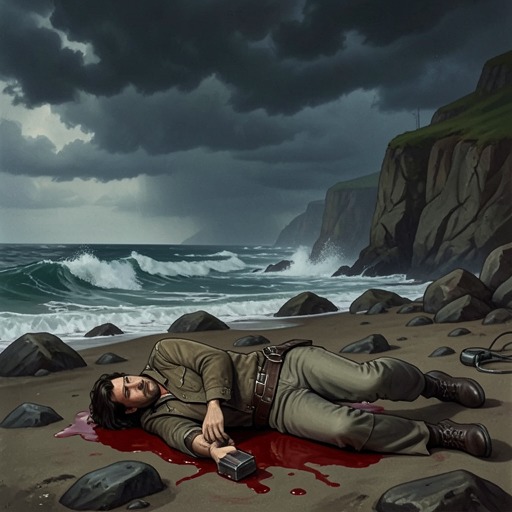
Roger first meets Bobby at the cliffs, where Bobby is beside a fallen man and waiting for help. Roger identifies himself as a stranger visiting the district to look at a house. He comes down to the narrow ledge, stays with the body while Bobby goes for assistance, and tells Bobby that he will remain until the police arrive. Bobby leaves grateful for his help. In this first encounter Roger is positioned as an outsider who performs an apparently decent act at a moment of crisis.
His account also gives him a credible reason to be in the area: he says he has come to look at a house. When Lady Frances Derwent later asks a house agent about a Mr Bassington-ffrench, she learns that Roger had made inquiries about properties and had supplied his address at Merroway Court. The agent recalls him as visibly affected by the death at the cliffs and confirms that he stayed with the body until the police came. These details make Roger’s conduct seem open rather than suspicious, and Lady Frances considers whether he might be entirely innocent.
Roger returns the following afternoon and is introduced to Lady Frances at tea by Sylvia Bassington-ffrench, who identifies him as her brother-in-law. His presence in Sylvia’s household gives him a second, socially established identity in the story: he is not merely a visitor connected to the cliff incident but a relative within the family at Merroway Court. When the subject of the dead man arises, Roger again volunteers that he was there and had stayed with the body. The repetition reinforces his apparent candour even as Lady Frances notices the coincidence.
Suspicion and Deception
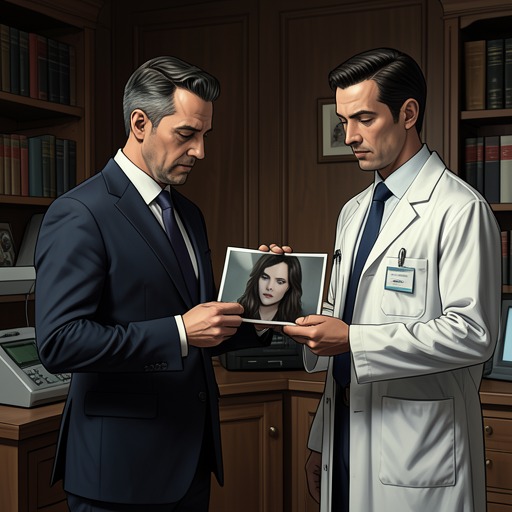
The apparently straightforward account of Roger’s involvement at the cliffs becomes one of the clues in Lady Frances and Bobby’s investigation. They suspect that the dead man was pushed over the edge and reason that Roger may have been responsible: he was present, and the photograph they associate with the mystery disappeared. Lady Frances recounts this theory to Moira Nicholson, including the way Roger’s connection to the cliff and the missing photograph had focused their suspicions on him. At this point it remains the investigators’ conclusion, not a confession from Roger.
Roger’s later conduct shows how deliberately he manages what other people see. He explains that he had placed a forged letter from Bobby in the sequence of clues. He also describes waiting near the path after Bobby went to The Grange, striking him from behind, carrying him to his car, and concealing him in the car’s boot before driving away. The account turns Bobby’s apparent independent movements into evidence of how closely Roger had monitored and controlled him. Roger treats forgery as a useful skill, not an isolated trick: a false document can direct suspicion, while a hidden captive can be moved without others knowing where he has gone.
He also exploits the force of physical evidence. After his plans are thwarted, Roger reflects that he had accepted the boot among the broken glass as proof of cause and effect, despite the apparent impossibility that a man tied up as Bobby was could have thrown it through a skylight. His mistake exposes the same vulnerability he had used against others: a convincing arrangement of objects can persuade an observer to accept an explanation that does not withstand scrutiny. In his own case, the misleading evidence does not secure the result he expected.
Criminal Scheme and Murder
In his letter, Roger explains that he had obtained money and was making progress with what he calls the Henry plan. He says he was not in a hurry to deal with Tommy and believed he could wait; he also regarded Nicholson as someone who could be removed when the time came. His account identifies the people around the scheme as obstacles and prospective targets, while showing that he was willing to postpone some actions when they were not yet necessary.
Roger explicitly admits that Henry Bassington-ffrench did not die by suicide: Roger killed him. He says that, during a conversation in the garden, he realized there was no time to waste and went straight inside. An aeroplane passing overhead gave him the opportunity to shoot Henry while the noise masked the sound. Roger then made the room support a false account of the death: he wrote an affecting suicide letter, wiped his fingerprints from the revolver, placed it in Henry’s hand, and left the study locked from the outside with a key that fitted the lock. He also describes arranging a timed device in the chimney to go off after he had left. The confession reveals a murder designed not merely to kill Henry but to make the death appear self-inflicted and to delay or confuse discovery.
Character and Narrative Role
Roger’s methods depend on making ordinary appearances serve extraordinary purposes. A visit to inspect houses supplies a credible explanation for his presence; staying with the body makes him appear helpful; and his place in Sylvia’s family gives him access to a household in which he can operate. Forged letters, planted clues, concealed movement, and a staged suicide extend the same strategy from social performance to physical evidence. The recurring contrast is between what a scene seems to prove and what Roger has arranged it to prove.
His manner remains controlled even when his schemes fail. After being overpowered, he calmly explains his error about the boot and acknowledges that Bobby and Lady Frances have won that round, describing the result as unexpected and regrettable. He takes evident satisfaction in explaining how he had fooled them and how he captured Bobby. That composure makes him more than a hidden culprit: he is also a commentator on the mechanics of deception, attentive to how clues shape belief and willing to treat criminal ingenuity as a craft.
The closing letter preserves that theatrical self-image. Roger signs himself as his recipients’ affectionate enemy and the bold, bad villain of the piece. The flourish acknowledges the role he has played while refusing any appearance of remorse. Across his appearances, the contrast between helpful stranger, respectable relative, and self-declared villain is not a change of character so much as a revelation of how effectively he can make one identity conceal another.